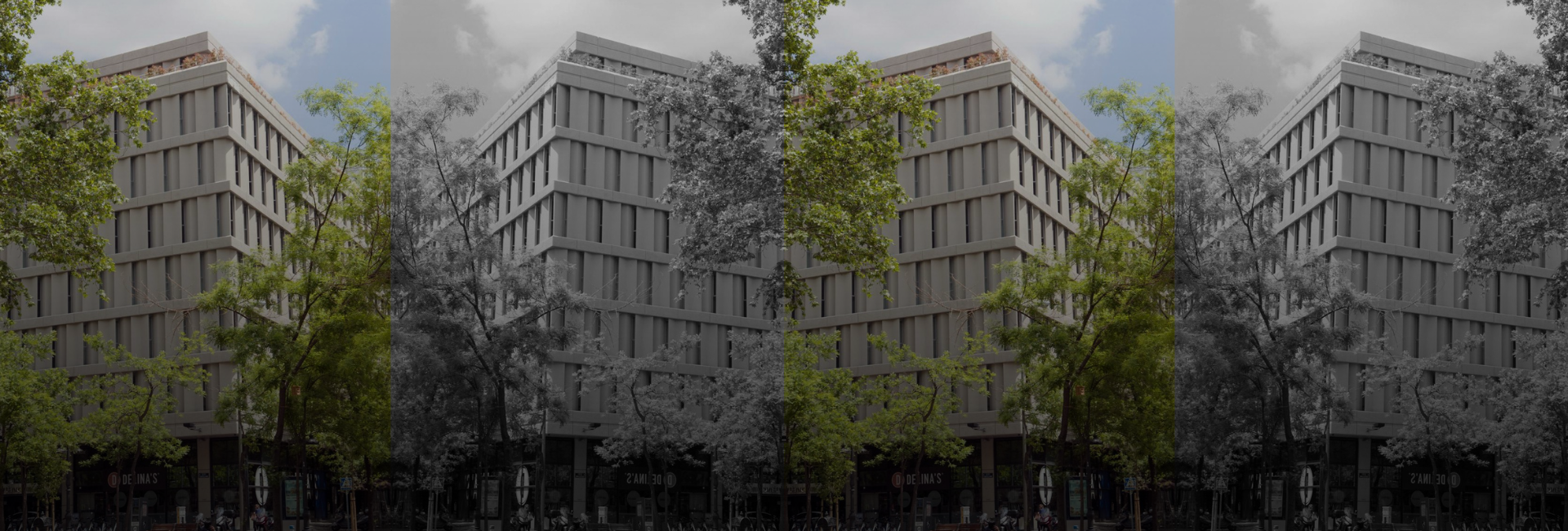
IBM Buildings in Spain
In the 1960s, computing meant IBM. The company's growth seemed boundless, and it quickly outgrew the United States. Through international expansion, the corporation established sites across the globe—and for once, Spain was among them. This week, we explore the two buildings the "Blue Giant" erected on Spanish soil.
- Compartir


A Bit of History
In 1890, Herman Hollerith's tabulating machine was selected by the U.S. Government to conduct the national census. Nine years later, he added calculation capabilities for accounting purposes, and by 1896 had founded the Tabulating Machine Company to commercially exploit what many consider history's first computer.
By 1924, after several mergers and ventures into unexpected products—even industrial meat slicers—the company adopted its current name, IBM, and refocused exclusively on business tabulation solutions. This mission resembles its present-day activity, though separated by an immense technological chasm. That gap began to narrow in 1944 with the Mark I, a five-ton behemoth that became the first machine to perform mathematical operations autonomously.
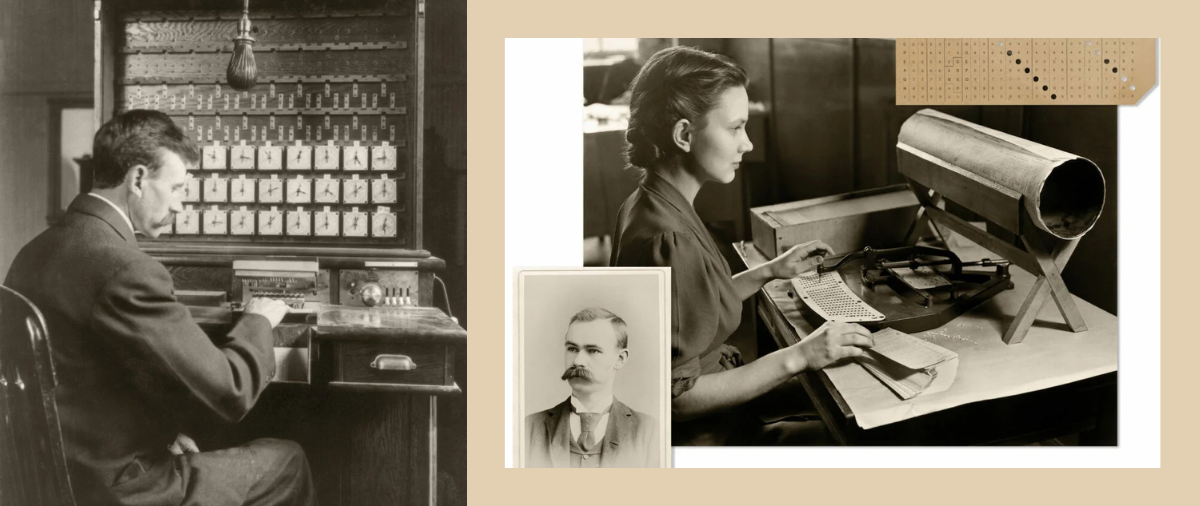
MIT Technology Review montage showing a photo of Hollerith, a US Census employee using the pantograph and a punch card.
What followed was the era of mainframe computers and IBM's global conquest. The System/360, with its interchangeable software and peripherals, proved an unqualified success. By 1964, International Business Machines Corporation was manufacturing 70% of the world's computing equipment, with ambitions extending far beyond American borders.
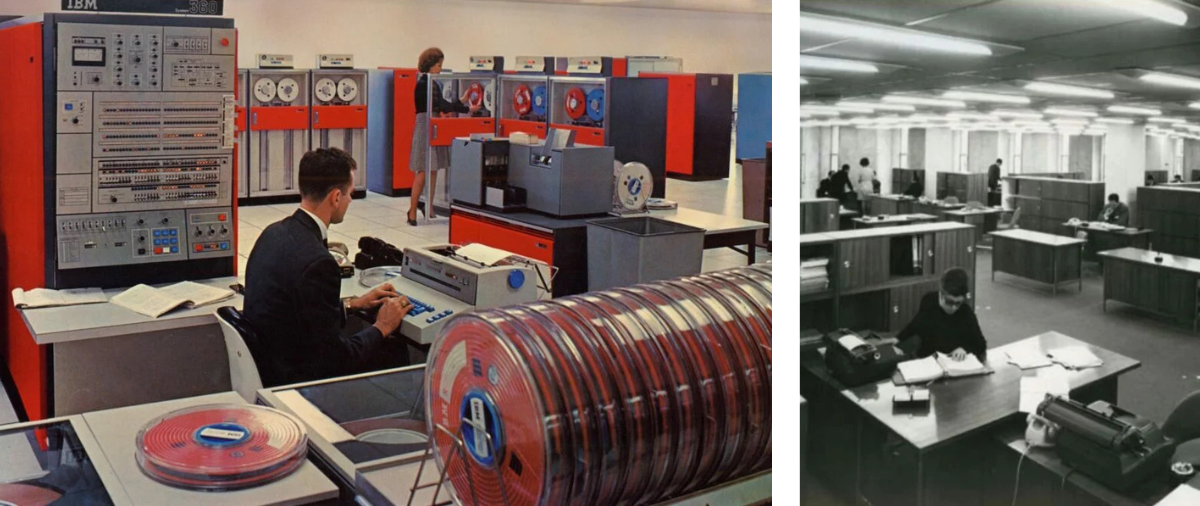
IBM headquarters
Which brings us here. During that planetary expansion, IBM commissioned some of the finest corporate headquarters in mid-20th century architecture. Remarkably, they did so with restraint, imposing no aesthetic dogma beyond their operational requirements. Rather than importing their own architects or enforcing a unified visual identity, they sought out prestigious local talent and collaborated respectfully, though never compromising their technical standards. The results were mixed: sometimes brilliant, sometimes less so.
In Spain, two buildings define IBM's footprint: one in Madrid, one in Barcelona. Both, avant-garde works, though unequally regarded today.
Want to know what happened to each? One succeeded magnificently, the other... not so much. Need more incentive to join us? How about two names: Fisac and Coderch.
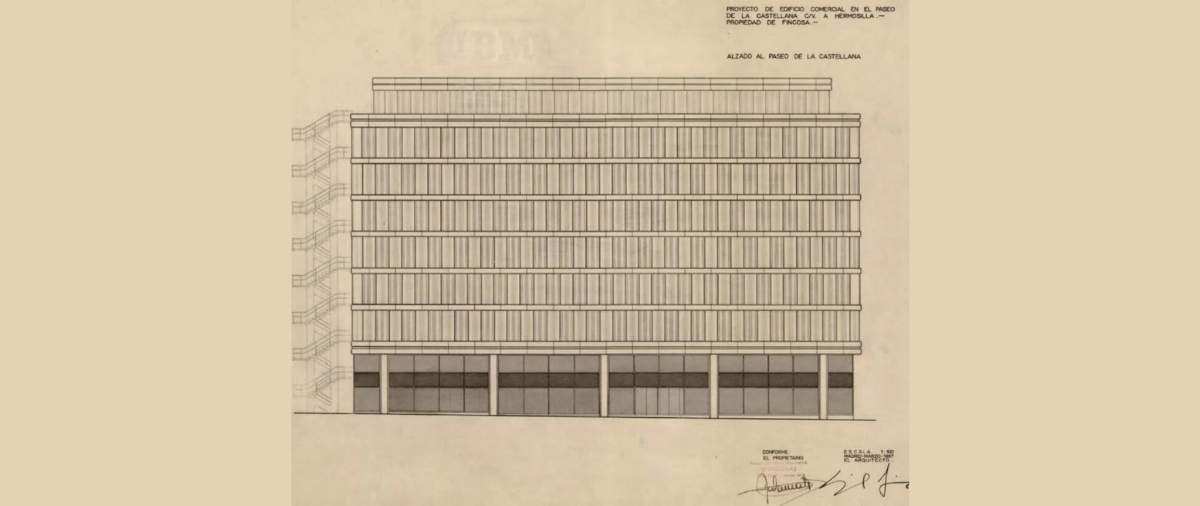
Elevation of the IBM Building facing Paseo de la Castellana.
.png)
Tests on the façade of Coderch's studio. | Section of Coderch's façade that IBM forced to be preserved after leaving the project.
Fisac recalled: "One day the president of IBM Spain came to see me, saying they wanted me to design a building. I was quite surprised, as clients like that don't usually appear out of nowhere. Later I discovered that headquarters in the United States had asked him to compile a list of potential architects and, after visiting their work, they'd chosen me."
.png)
IBM building on Paseo de la Castellana, Madrid
.png)
Newly manufactured boomerang parts. | IBM building in Madrid
These words reveal IBM's selection process. Fisac must have been approached around 1965, precisely when he was designing the Computer Center at University City, a building meant to house a computer IBM had donated to Complutense University. His proposals apparently impressed the "Blue Giant," because when they acquired the site at Paseo de la Castellana 4, they immediately abandoned the project already underway.
.png)
Miguel Fisac University City Computing Centre.
The building Oriol e Ybarra had designed for the original owners—construction firm FINCOSA—featured curtain walls. Despite provisions for anti-glare and infrared-filtering glass, IBM rejected this approach for a west-facing façade. Instead, Fisac proposed his own signature element: repeating vertical strips of concrete with hollow, boomerang-shaped sections filled with polystyrene. These prefabricated components, so characteristic of the Manchegan architect, today feel utterly contemporary.
The result was an unmistakable façade comprising 693 identical elements, plus 14 corner pieces. This succession of boomerangs leaves 30-centimetres openings across one-ninth of each floor's perimeter: standard illumination for a conventional room, but without direct sunlight. The solution also reveals the building's structure, exposing floor slabs and columns on the lower two levels.
Brutalism in its purest expression: bare concrete, structure as protagonist, function transformed into aesthetic. Anyone who has walked past Fisac's building and glanced upward knows exactly what we mean. The design is so distinctive that for years it became inextricably linked with IBM's identity. From the street, it appears hermetic; an impenetrable bunker concealing a secret world where marvels unfold. Much like what most of us imagine when staring at a powered-down computer.
IBM Headquarters in Barcelona
In Barcelona's case, we rewind to 1969—and given how they selected Fisac, they ought to have mirrored that process. Presumably, they compiled a roster of esteemed Catalan architects, toured their masterpieces, and crowned Coderch. Yet despite the ostensibly simpler facade compared to Madrid's, the backstory brims with intrigue. Coderch himself disavowed the final building.
He commenced with facade studies, dispatching prototypes—elevations and sections—to the firm from his studio. Dubiously technical pretexts prompted relentless alterations to plans en route to the United States, until the architect withdrew. Astonishingly, IBM clung to Coderch's facade vision, though it left even him unconvinced.
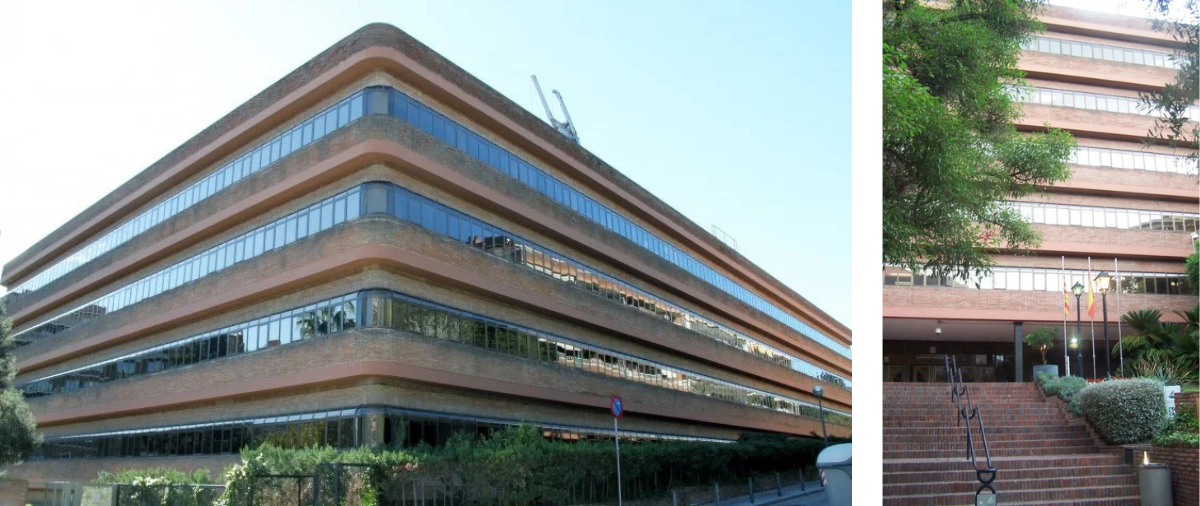
Entrance to the IBM Building in Barcelona.
The engineering firm Màster and Robert Brufau's studio took over the project, honouring Coderch's signature curved-glass section. Here legend ignites: Brufau claimed payment for the order, yet consensus holds Coderch pocketed nothing. Post-completion, IBM still pressed him to claim authorship.
There's a story worth telling here, and if you'll permit us, we'll embrace the Hollywood version: Picture the early 1970s, the project finished, a grand opening with a gala dinner at Barcelona's Ritz. Among the attendees was IBM's CEO—at the time, one of the most powerful figures in the world. Reportedly, he insisted on congratulating Coderch for providing the conceptual foundation of the building. He also purportedly pressured the architect to fill out a blank check in exchange for associating his name with the new headquarters. Coderch's response? He tore up the check before everyone assembled and declared: "The Coderchs are not for sale."
.png)
Armchair designed for the IBM Building's furnishings. | Interior of the IBM Building
PHOTOS: Pinterest, MIT Technology Review, NBC News, Barcelofilia, Fundación Fisac, Arxiu Coderch, Recordando a Coderch, Metalocus, Arquitectura Viva, Mikisimba, Ximo Michavila, Mario Roberto Álvarez, Wikipedia, Decora Arquitectura,
Fuentes bibliográficas: Wikipedia; Fundación Fisac, Epidermis de hormigón, Fisac y el edificio IBM, de Ramón V. Díaz del Campo Martín-Mantero; Miguel Fisac: Arquitecturas para la investigación y la industria, de Diego Peris Sánchez; “Mitad Fábrica, mitad convento”. La Casa Tapies, de Antoni Pérez Mañosas.
 Contact
 Call
Call
